

Guide to Choosing the Best Flight Simulators for Pilot Training

Choosing the best flight simulators for pilot training is a critical decision for any aviation school or flight instructor. The right simulator can enhance student learning, improve safety, and reduce training costs, while the wrong choice might end up underused or quickly outdated. This guide offers a practical approach to evaluating and selecting the most suitable flight simulators for pilot training, tailored to your program’s specific needs.
Why Flight Simulators Are Essential in Pilot Training
Flight simulators are essential tools in modern pilot training programs, providing safe, cost-effective learning environments. Simulators help students avoid high aircraft rental costs and reduce the total expense of earning a private pilot license, which can exceed $70,000. By enabling repeated practice of procedures without the risks and costs associated with real aircraft, flight simulators generate significant savings for both schools and students.
Safety is a primary advantage of simulation. In a flight simulator, trainees safely experience and react to emergencies or bad weather with zero risk. Students can practice situations such as engine failure or inadvertently flying into cloud in a controlled setting, building confidence and turning mistakes into valuable lessons. High-quality simulators are essential when safety and skill development are priorities, making them top choices for pilot training.
Simulators offer consistency and flexibility for scheduling. Training continues regardless of weather or aircraft availability, standardizing lessons and supporting student progress. This reliability makes simulators indispensable for maintaining training schedules and quality.
Understanding Different Types of Flight Simulators
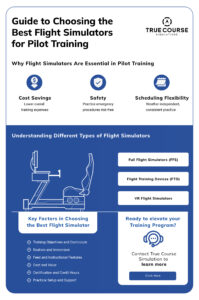
Knowing the different types of flight simulators is essential for choosing the one that best fits your pilot training needs. The main categories are:
- Full Flight Simulators (FFS): These are high-end, motion-platform simulators that replicate the entire cockpit of an aircraft. They provide realistic in-flight sensations and are often used by airlines and large training centers for professional pilot training. FFS units offer top realism but are extremely expensive and complex to operate (often costing millions of dollars each).
- Flight Training Devices (FTD): These are fixed-base simulators, typically featuring a replica cockpit and instrument panel, but without motion capabilities. FTDs are used for procedure training, instrument flight practice, and basic cockpit familiarization. They are more affordable than full-motion simulators and are commonly found in flight schools for training purposes, such as instrument rating training.
- VR Flight Simulators/Immersive Flight Simulators : This newer category utilizes virtual reality (VR) and mixed reality (MR) technology and, in some cases, compact motion platforms to create an immersive 360° training environment. Students wear a headset and use real flight controls, experiencing a virtual cockpit and scenery that responds to their inputs. These systems, such as True Course Simulations’ immersive flight sims -, offer high realism at a fraction of the cost of full-motion sims. They are quickly becoming some of the best flight simulators for pilot training because they strike a balance between realism, cost, and flexibility.
Each simulator type fulfills a unique role in pilot training. Full Flight Simulators deliver ultimate realism for advanced instruction, while FTDs and immersive VR-based devices excel in private pilot and instrument training. Many flight schools seek simulators that balance realism, practicality, and affordability—where VR and immersive devices stand out.
Key Factors in Choosing the Best Flight Simulator
Several factors determine if a simulator is right for your pilot training program. Evaluate these to ensure your choice fits your training needs:
- Training Objectives and Curriculum Alignment: Select a simulator that aligns with your specific training objectives. For instance, a basic trainer for private pilot students might focus on fundamental maneuvers, while an instrument training device should have accurate cockpit instruments and navigation aids. The simulator should integrate with your curriculum or come with its own lesson content, so that each session closely supports what students need to learn. If you’re training new pilots on fundamentals or teaching instrument procedures, ensure the device is equipped for these tasks and fits seamlessly into your lesson plans.
- Realism and Immersion: The effectiveness of a flight simulator depends largely on how realistic the experience is. Look for high-fidelity controls (yokes, rudder pedals, throttles) that feel like those in actual aircraft. Visual systems are also critical; high-resolution displays or VR headsets will provide students with a convincing 360° view of their surroundings. Some of the best flight simulators for pilot training even include motion feedback or vibration to simulate turbulence, engine rumble, or the feeling of landing. A more immersive simulator will better engage students and reinforce proper flying techniques.
- Feedback and Instructional Features: Consider the available feedback tools for instructors and students. Does the simulator record flight data or provide performance metrics? Can an instructor monitor playback a student’s session? Advanced systems, such as True Course Simulations’ Virtual Flight Instructor, can track student progress and even provide real-time coaching, allowing one instructor to effectively oversee multiple students. The best flight simulators incorporate features that enable instructors to identify mistakes and enable students to learn from them, whether through on-screen guidance, post-flight debriefing tools, or automated progress tracking.
- Training Content and Scenarios: A simulator is far more valuable if it comes with a library of training scenarios or lesson modules. For example, True Course Simulations provides over 60 ready-made lessons covering everything from basic takeoffs to cross-country flights. This built-in content means you can start training with structured exercises on day one. If a simulator doesn’t include scenarios, check that it allows you to create or customize your own. The best flight simulators will support a variety of scenarios (normal flights, emergencies, different weather, etc.) to give students a well-rounded experience.
- Cost and Value: Budget is always a consideration. Prices for flight simulators range widely, from a few thousand dollars for simple PC-based setups to millions for full-motion rigs. Determine your budget and then evaluate what each option provides for the price. Keep in mind the potential savings a simulator can generate: every hour a student trains in a sim is an hour saved on real aircraft rental and fuel. By reducing the flight hours required to reach proficiency, a good simulator can pay for itself over time. When comparing costs, include any software licensing or maintenance fees.
- Certification and Credit Hours: If you want students to log simulator time toward their required flight hours, make sure the device meets regulatory standards. In the U.S., for example, an FAA-approved Aviation Training Device (ATD) can allow a certain number of hours to count toward pilot certificate requirements. Ensure the simulator you choose has the necessary certification (such as Basic or Advanced ATD approval) if logging time is important for your program. Even when not used for loggable hours, a high-quality simulator remains extremely valuable for skill building.
- Practical Setup and Support: Consider the practical aspects of owning and operating the simulator. How much space do you need? Full Flight Simulators require an entire room, whereas a VR-based immersive flight simulator only needs a small corner of a classroom. Check what kind of technical support and training the manufacturer provides. The best flight simulator providers offer installation assistance, instructor training, and responsive support in case issues arise. Also consider scalability, can you add more simulators later or easily update the system with new software and aircraft models? The best flight simulators for pilot training are those that you can rely on for years, offering solid customer support and upgrade paths as technology advances.
Weighing factors such as training needs, realism, feedback, content, cost, certification, and logistics enables you to confidently choose the best flight simulators for your students and instructors.
Ready to Elevate Your Training Program?
The benefits of using the best flight simulators for pilot training are clear: reduced costs, improved safety, and accelerated learning. If you’re looking to give your students an edge and modernize your curriculum, it’s time to explore what True Course Simulations has to offer. Contact True Course Simulations today to learn more or to schedule a hands-on demo of our immersive VR flight training systems. See for yourself how a high-quality simulator can transform your flight training program and help your student pilots earn their wings more efficiently than ever.
I would suggest ending the article here – it’s pretty long already.
Frequently Asked Questions about Flight Simulators in Training
What are the best flight simulators for pilot training?
The “best” flight simulator depends on your training needs. For most flight schools and pilot training programs, the best options are advanced FAA-approved training devices or VR-based simulators that offer realistic controls, visuals, and feedback. A full-motion simulator (FFS) provides the highest level of realism but is very expensive; therefore, many schools find that modern VR flight simulators, such as True Course Simulations’ Immersive Training Device, strike the perfect balance. These systems deliver authentic cockpit experiences and proven training results at a fraction of the cost of airline-style simulators, making them some of the best flight simulators for pilot training in general use.
How do flight simulators reduce pilot training costs?
Flight simulators help cut training costs in several ways. Every hour a student spends in a simulator is an hour not spent renting an aircraft and burning fuel. For example, if a training airplane costs around $180 per hour to operate, using a simulator for even 10 hours of practice saves roughly $1,800 in aircraft expenses. Simulators also allow students to reach required proficiency in fewer flight hours by providing extra practice: better-prepared students don’t need as much repetition in the real airplane. Additionally, simulators enable training during adverse weather conditions or aircraft maintenance downtime, resulting in fewer schedule delays. All of this means students can progress more quickly and with less wasted resources. Studies have shown significant time savings; one university program achieved a 30% faster completion of initial solo flights by using VR simulators early in training, which directly translates to cost savings for both the student and the institution.
Can simulator training replace actual flight hours?
No, flight simulators can’t completely replace real flight experience, nor are they meant to. There is no substitute for flying an actual aircraft when it comes to earning a pilot’s license. However, simulators are extremely valuable as a supplement to real flying. They allow students to practice procedures, build muscle memory, and learn complex concepts on the ground. Some licensing requirements allow students to credit a certain number of simulator hours toward the total (for instance, a portion of instrument training can be completed in approved simulators). But even beyond logged hours, the role of the simulator is to enhance pilot training: it prepares students so that when they do get in the airplane, they learn more efficiently. In short, simulator training and real flight training go hand in hand; using a simulator extensively will make a student’s actual flight hours more productive and safe. However, ultimately, a pilot must demonstrate their skills in a real aircraft.
What features should the best flight simulators for pilot training have?
The best flight simulators for pilot training share a few key features. First, they offer realistic flight controls and instrumentation that mimic the airplanes students will fly, which builds proper habits and familiarity. Second, they provide immersive visuals (wide-screen displays or VR) with a smooth, high-resolution view of the outside world, so pilots learn to scan their environment and instruments naturally. Many top simulators include motion or haptic feedback, which adds sensations for things like turbulence, turns, and landings to reinforce the feeling of flight. Another important feature is a variety of training scenarios (normal operations, emergencies, and different weather conditions) to give a comprehensive experience. Finally, good training simulators come with instructor tools: the ability to monitor flights, introduce failures or weather changes at will, and record or replay sessions. All these features ensure that a simulator isn’t just a video game, but a serious educational tool that produces real improvements in a pilot’s skills.
How do I integrate a new flight simulator into my pilot training program?
Start by aligning the simulator sessions with your existing curriculum. Determine which lessons (e.g. basic maneuvers, navigation, instrument scans, emergency procedures) can be practiced in the simulator before or after the actual flight lesson. It’s often best to introduce the simulator early in training, have students use it to rehearse pre-flight checklists, cockpit familiarization, and simple maneuvers. Make simulator time a regular part of the schedule, especially on days when weather prevents actual flying (so learning continues without interruption). Train your instructors on the simulator as well, so they know how to set up scenarios and use the instructor tools for monitoring and feedback. Some schools assign homework on the simulator: for example, a student might be required to fly a virtual cross-country route or practice radio calls in the sim to build proficiency. By treating the simulator as an integral classroom tool rather than an add-on, you’ll maximize its benefits. Over time, you’ll likely find that students who consistently use the simulator perform better and need fewer hours in the real aircraft to meet standards.