

True Course Simulations: Innovative Solutions for Pilot Training
By tcsims
– Reviewed by Glen Ross, True Course Simulations
|
Date: September 1, 2025
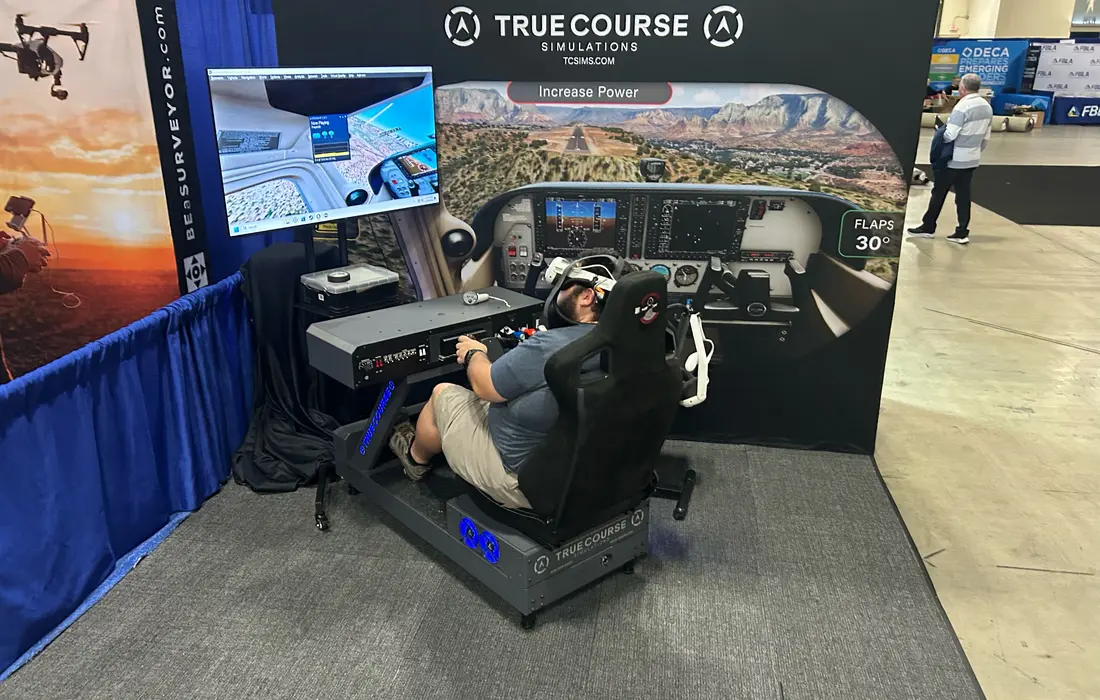
Pilot training technology is evolving fast, and True Course Simulations (TCS) is helping flight programs keep up with its Immersive Flight Simulators, a VR flight simulator that gives students realistic, repeatable practice at a fraction of the cost of extra aircraft time. Through virtual reality flight training built around the Immersive Flight Simulators, TCS supports programs from universities to local flight schools and high school aviation courses. The goal is straightforward: enhance instructor efficiency, accelerate student proficiency, reduce training costs, and reinforce safety—building on proven results from a virtual reality flight training program at Embry-Riddle, where students cut time to solo by more than 30 percent.
Instead of adding more aircraft or stretching instructor capacity, TCS focuses on making every training minute count. By giving students a realistic place to practice checklists, maneuvers, and emergencies before they ever touch an airplane, the Immersive Flight Simulators help schools deliver cleaner first flights, smoother progress to solo, and stronger pilot confidence from day one.
Immersive Flight Simulators: A Cutting-Edge VR Flight Simulator
The Immersive Flight Simulators is a turnkey simulation station with a robust steel frame, motion actuators, professional-grade controls, and a high-definition VR headset. In an engine-failure scenario, for example, the motion platform shudders as power drops, and the student must work through the emergency checklist while choosing a safe landing site in realistic terrain. Students see a 360-degree view of the outside world and feel motion cues that mirror aircraft behavior. These realistic sessions help bridge the gap between book and aircraft by letting students rehearse demanding situations on the ground before they face them in the sky.
Virtual Flight Instructor and Integrated Curriculum
TCS’s market-leading proprietary Virtual Flight Instructor Courseware offers an integrated aviation education solution that guides students through a complete training sequence. Each lesson follows a simple “Read – Watch – Do” pattern: students read a short briefing, watch a demonstration of the maneuver, and then practice it interactively on the simulator. The curriculum covers the whole Private Pilot syllabus, from basic attitudes, pattern work and navigation, to emergency procedures, so learners can build skills step by step. Because the system records every session, instructors can review performance data, spot trouble areas, and assign extra simulator practice where it will have the most impact. This mirrors how VR flight simulators are changing the way we train future pilots, combining classroom learning with frequent, focused repetition.
Another strength of the Virtual Flight Instructor is accessibility. Students can train day or night, in any weather, without needing an aircraft or instructor in the seat beside them. Lessons are self-paced, so one educator or instructor can supervise several simulator stations at once and focus on debriefing and coaching. That flexibility helps schools make better use of limited instructor hours and aircraft slots while giving students more chances to practice.
Key Benefits of the TCS Immersive Training System
Flight programs that adopt the Virtual Flight Instructor Courseware and Immersive Flight Simulators report several clear gains:
Greater instructor efficiency. Self-guided lessons reduce how often instructors repeat the same basic demonstrations. One instructor can monitor multiple students in the simulator, check progress dashboards, and spend more time on higher-level coaching.
Higher student proficiency. Students can repeat maneuvers many times in VR until they reach a consistent standard, which helps them arrive at the aircraft better prepared and less anxious. In a study of 58 students at Embry-Riddle Aeronautical University, those who used a VR-based program before their first flights reached solo more than 30 percent faster than a traditional group, echoing results from the VR-driven time-to-solo study. (Here, as an academic, I immediately think, ‘where are the citations to support these claims?’.
Lower training costs. Every hour in the Immersive Flight Simulators saves fuel, maintenance, and aircraft wear while still building real skill. Schools can move part of the early phases of training and scenario practice into VR and reserve aircraft time for proving, refinement, checkrides, and real-world conditions, keeping pilot training more accessible.
Enhanced safety. The Immersive Flight Simulators makes practicing high-risk situations that are unsafe to stage in an actual aircraft, such as engine failures after takeoff, deteriorating weather, and off-field landings. By using Immersive Sims, students can make mistakes, reset, and try again until their responses become calm and correct, improving safety for students, instructors, and equipment.
University Flight Programs
University aviation programs must serve large cohorts with limited aircraft and instructor capacity. By integrating the Virtual Flight Instructor Courseware and Immersive Flight Simulators into their syllabi, universities can increase training throughput without lowering standards. Some schools use a VR-first phase, where new students spend their first weeks training in Immersive sims before stepping into the airplane. At Embry-Riddle’s Daytona Beach campus, VR-based preflight immersion has helped in training student pilots in a new pre-flight immersion laboratory, so they reach solo sooner and with greater confidence.
Independent Flight Schools
Independent flight schools work in a cost-sensitive environment and feel the impact of weather delays, maintenance downtime, and instructor shortages. For these operators, the Immersive Flight Simulators offer a way to train smarter and protect margins. Every simulator hour reduces fuel burn and aircraft wear while still building skills and proficiency. Instructors can review simulator data, target coaching where it is needed, and keep aircraft lessons focused on higher-value objectives. Schools that adopt VR flight training for flight school operations also find it easier to keep students progressing when the weather or schedule would otherwise keep airplanes on the ground and students at home.
High School Aviation Programs
High school aviation programs and STEM academies introduce teenagers to aviation face tight limits on time in real aircraft. TCS helps bridge that gap with a VR training program that brings a cockpit experience into the classroom. Students can sit in a virtual aircraft, practice basic maneuvers, and with the expert guidance of the Virtual Instructor, work through parts of a private pilot syllabus in a safe environment. This early exposure makes aviation more concrete than textbooks alone and lets students test their interest before they commit to expensive training after graduation. Teachers can add simulator sessions into aerospace classes or after-school clubs, using the Virtual Flight Instructor to guide students while they supervise and support.
Ready to Elevate Your Pilot Training Program?
True Course Simulations is helping flight programs at every level revolutionize and modernize how they train pilots or deliver aviation/STEM programs. By combining a structured curriculum, led by the Virtual Flight Instructor with their Immersive Flight Simulators , TCS provides schools with a practical way to increase proficiency and enjoyment, improve safety, and control cost. Programs that blend VR sessions with aircraft time see students reach milestones sooner, with more confidence and stronger decision-making skills, while instructors gain a more flexible, efficient way to teach the next generation of pilots.
Contact True Course Simulations today to book a demo or discuss how to onboard this cutting-edge VR training system for your program. Experience firsthand how TCS’s pilot training technology can help your students achieve their aviation goals faster, more safely, and more cost-effectively. Let us help you bring a new level of innovation to your flight training and join the forward-thinking organizations already propelling their pilots to success with True Course Simulations.